


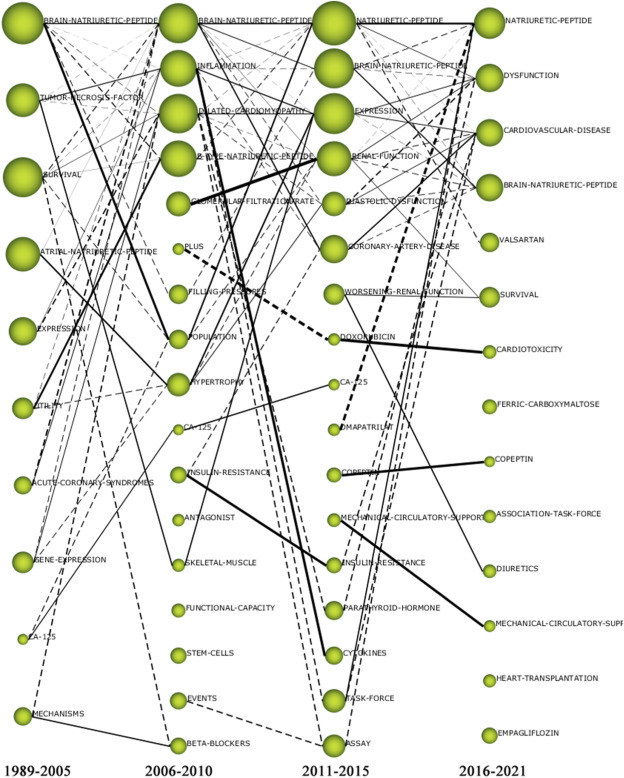
Global historical retrospect and future prospects on biomarkers of heart failure: A bibliometric analysis and science mapping
Heart failure is a rapidly growing public health problem and has become a major cause of hospitalization in middle-aged and older adults. Biomarkers are clinically important in managing heart failure...
Conclusions: Extensive national and inter-institutional collaboration should be enhanced to bridge the gap between developed and less developed countries in heart failure biomarkers research. The research in this field seems to have reached a relatively mature stage, with a decrease in research fervor in recent years. The study of the...

Sodium-Glucose Cotransporter-2 Inhibitors in Heart Failure With Mildly Reduced or Preserved Ejection Fraction: A Systematic Review and Meta-Analysis of Randomized Controlled Trials - PubMed
Source : https://pubmed.ncbi.nlm.nih.gov/36681210/
SGLT2i significantly reduce the combined risk of HF hospitalization or cardiovascular mortality among patients with HF and LVEF >40%. However, younger patients, racial minorities, and patients from Asia did not...
Conclusion: Studies showed that empagliflozin and dapagliflozin reduce the combined risk of CV death or HHF in patients with HFmrEF and HFpEF when added to a standard HF regimen. Given that benefit has now been demonstrated across the spectrum of HF, SGLT-2Is should be considered one of the standard HF pharmacotherapy.

Angiotensin pathways under therapy with empagliflozin in patients with chronic heart failure - PubMed
Source : https://pubmed.ncbi.nlm.nih.gov/36782339/
Our data indicate that empagliflozin might lead to an activation of both the Ang I-ACE-Ang II receptor axis and the Mas-axis pathway. Activation of the Ang I-ACE-Ang II receptor axis...
Conclusions: Our data indicate that empagliflozin might lead to an activation of both the Ang I-ACE-Ang II receptor axis and the Mas-axis pathway. Activation of the Ang I-ACE-Ang II receptor axis and the protective Mas-axis pathway after initiating treatment with empagliflozin was only seen in patients with ARB co-medication, in contrast to...
-
Heart Failure Connect3yrKey Points • Source: ESC Heart Failure • Conclusions/Relevance: “Our data indicate that empagliflozin might lead to an activation of both the Ang I–ACE–Ang II receptor axis and the Mas-axis pathway. Activation of the Show More
Acute Biomechanical Effects of Empagliflozin on Living Isolated Human Heart Failure Myocardium - Cardiovascular Drugs and Therapy
Source : https://link.springer.com/article/10.1007/s10557-023-07434-3
Purpose Multiple randomized controlled trials have presented SGLT2 inhibitors (SGLT2i) as novel pharmacological therapy for patients with heart failure, resulting in reductions in hospitalization for heart failure and mortality. Given...
Conclusion: The addition of empagliflozin to LMS from end-stage heart failure patients cultured in a biomimetic system improves contraction and relaxation kinetics by increasing total contraction duration without diminishing maximum force production. Therefore, we present convincing evidence that SGLT2i can directly act on the myocardium in...
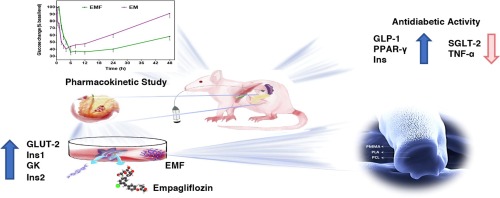
Oral empagliflozin-loaded tri-layer core-sheath fibers fabricated using tri-axial electrospinning: Enhanced in vitro and in vivo antidiabetic performance
Source : https://www.sciencedirect.com/science/article/abs/pii/S0378517323001369?via=ihub
Empagliflozin-loaded PCL/PLA/PMMA nanofibers (EMF) were produced by tri-axial ES. * The expression of glucokinase and GLUT-2 was increased by EMF in the rat β-cell line. * The bioavailability was improved...
Relevance: EMF is suggested as an unprecedented and promotive treatment approach for T2DM with a higher bioavailability and better antidiabetic effect compared to conventional dosage forms.