



The future of heart failure with preserved ejection fraction : Deep phenotyping for targeted therapeutics - PubMed
Source : https://pubmed.ncbi.nlm.nih.gov/35767073/
Heart failure (HF) with preserved ejection fraction (HFpEF) is a multi-organ, systemic syndrome that involves multiple cardiac and extracardiac pathophysiologic abnormalities. Because HFpEF is a heterogeneous syndrome and resistant to...
Relevance: Here we provide a framework for understanding the phenotype-based approach to HFpEF by reviewing (1) the historical context of HFpEF; (2) the current HFpEF paradigm of comorbidity-induced inflammation and endothelial dysfunction; (3) various methods of sub-phenotyping HFpEF; (4) comorbidity-based classification and treatment of...
-
Heart Failure Connect4yrKey Points • Source: Herz • Relevance: “Here we provide a framework for understanding the phenotype-based approach to HFpEF by reviewing (1) the historical context of HFpEF; (2) the current HFpEF paradigm of comorbidity-induced Show More
Pharmacological analysis of Empagliflozin: Acting through the CaMKII pathway in type 2 diabetes and acute cardiovascular events
Source : https://journals.plos.org/plosone/article?id=10.1371/journal.pone.0270152
Background Type 2 diabetes mellitus is a high-risk factor for acute cardiovascular events. Some reports show that Empagliflozin has a protective effect on cardiovascular events and diabetes mellitus, and Empagliflozin...
Conclusion: In this study, we obtained CaMK2G and PPP1CA, genes associated with the CaMKII pathway and type 2 diabetes and acute cardiovascular events, by integrative gene analysis and validated their expression in the relevant dataset. We also derived that Empagliflozin acts on amino acid TRP-125 of CaMK2G gene and GLN-249 ASP-210 ASP-208 of...

Euglycaemic diabetic ketoacidosis in a patient with pancreatitis and type 2 diabetes on empagliflozin
Source : https://casereports.bmj.com/content/15/6/e247921
Sodium glucose cotransporter-2 (SGLT2) inhibitors are glucose-lowering drugs with proven efficacy in treating type 2 diabetes mellitus, and more recently, have been shown to improve heart failure outcomes in patients...
Relevance: We present the case of a man with recent SGLT2 inhibitor use and multiple other risk factors who developed EDKA.
Cell-Target-Specific Anti-Inflammatory Effect of Empagliflozin: In Vitro Evidence in Human Cardiomyocytes
Source : https://www.frontiersin.org/articles/10.3389/fmolb.2022.879522/full
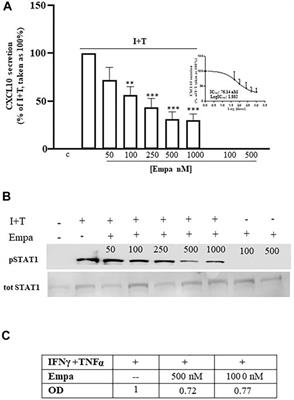
The antidiabetic sodium-glucose cotransporter type 2 inhibitor (SGLT2i) empagliflozin efficiently reduces heart failure (HF) hospitalization and cardiovascular death in type 2 diabetes (T2D). Empagliflozin-cardioprotection likely includes anti-inflammatory effects, regardless glucose...
Relevance: This preliminary study aims to explore whether empagliflozin directly affects Th1-challenged human cardiomyocytes, in terms of CXCL10 targeting. To this purpose, empagliflozin dose–response curves were performed in cultured human cardiomyocytes maintained within a Th1-dominant inflammatory microenvironment (IFNγ/TNFα), and CXCL10...

Prevention of Cardiorenal Complications with Sodium-Glucose Cotransporter Type 2 Inhibitors: A Narrative Review - Diabetes Therapy
Source : https://link.springer.com/article/10.1007/s13300-022-01277-1
Heart failure (HF) and chronic kidney disease (CKD) are the most frequent first cardiorenal conditions in patients with type 2 diabetes (T2D), which can be exacerbated by other comorbidities, such...
Conclusion: In this review, we summarize and discuss the evidence regarding the mechanisms of action, the efficacy and safety profiles, and the clinical guidelines on the use of the therapeutic class of SGLT2i, highlighting their role in cardiorenal prevention beyond glycemic control.