


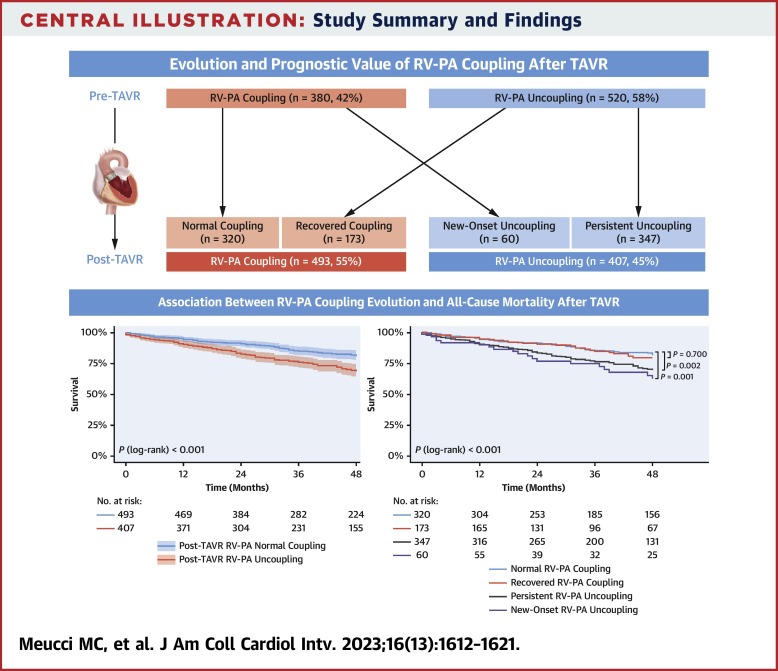
Evolution and Prognostic Impact of Right Ventricular-Pulmonary Artery Coupling After Transcatheter Aortic Valve Replacement
Source : https://www.sciencedirect.com/science/article/abs/pii/S1936879823008233?via=ihub
There is limited evidence regarding the association between right ventricular-to-pulmonary artery (RV-PA) coupling and outcomes after transcatheter ao...
Conclusions: Post-TAVR RV-PA uncoupling is an independent predictor of long-term mortality, irrespective of coupling before intervention. Assessment of TAPSE/PASP response after TAVR may be helpful to improve risk stratification.

TAVR in Bicuspid Aortic Stenosis: Current Evidence and Proposal for a Randomized Controlled Trial Design
Source : https://www.sciencedirect.com/science/article/abs/pii/S1936879823006921?via=ihub
When taking a closer look at the available evidence on TAVR to treat patients with bicuspid AS, it can be concluded that this evidence is based mainly on observational or...
Conclusions: As TAVR is expanding to younger patients with longer life expectancy, the initiation of a dedicated prospective RCT studying the safety, effectiveness, and limitations of TAVR vs SAVR in different types of bicuspid AS is highly needed.
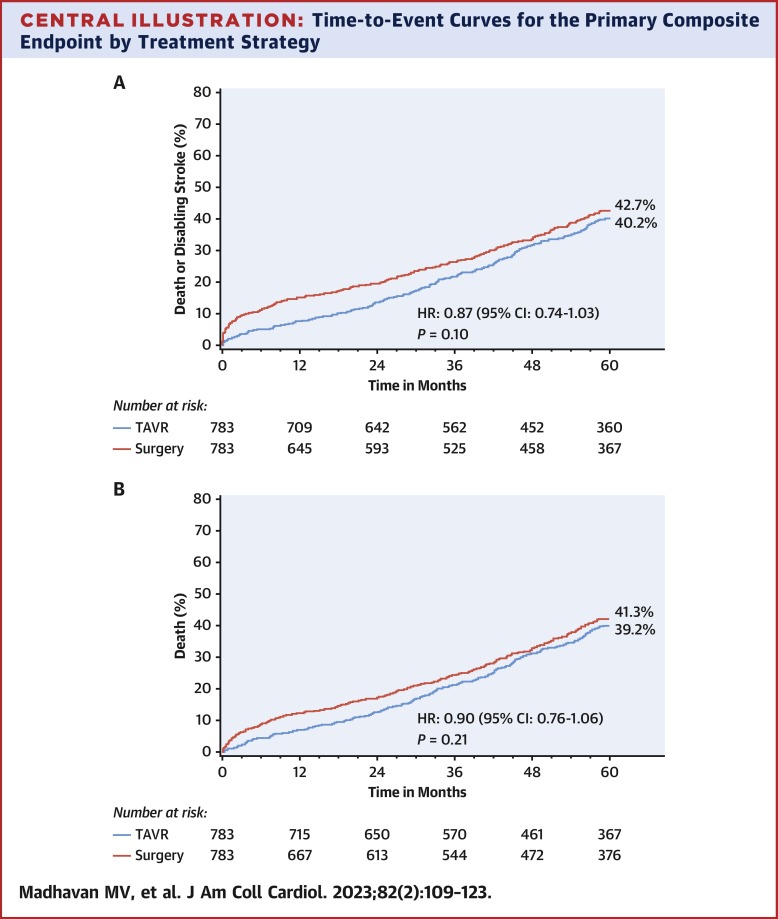
Outcomes of SAPIEN 3 Transcatheter Aortic Valve Replacement Compared With Surgical Valve Replacement in Intermediate-Risk Patients
Source : https://www.sciencedirect.com/science/article/abs/pii/S0735109723055900?via=ihub
Previous studies demonstrated transcatheter aortic valve replacement (TAVR) with an earlier generation balloon-expandable valve to be noninferior to s...
Conclusions: In this propensity-matched analysis of intermediate-risk patients, 5-year rates of death and disabling stroke were similar between S3 TAVR and SAVR. Rates of structural valve deterioration–related hemodynamic valve deterioration were similar, but paravalvular regurgitation was more common after S3 TAVR. Longer-term follow-up is...
-
Aortic Stenosis Connect3yrKey Points • Source: Journal of the American College of Cardiology • Conclusions: “In this propensity-matched analysis of 783 matched pairs of intermediate-risk patients with severe, symptomatic AS who underwent aortic valve replacement, rates Show More

Commissural and coronary alignment of the Venus-A valve after transcatheter aortic valve replacement: a retrospective cross-sectional study
Source : https://cdt.amegroups.com/article/view/113538/html
Commissural and coronary alignment of the Venus-A valve after transcatheter aortic valve replacement: a retrospective cross-sectional study
Conclusions: The results showed that commissural or coronary alignment could not be achieved with the Venus-A valve using a standard system delivery technique. Therefore, specific methods to attain alignment with the Venus-A valve need to be identified.

Final 3-Year Outcomes of a Randomized Trial Comparing a Self-Expanding to a Balloon-Expandable Transcatheter Aortic Valve - PubMed
Source : https://pubmed.ncbi.nlm.nih.gov/37417229/
URL: https://clinicaltrials.gov, Unique identifier: NCT03011346.
Conclusions: Early differences between NEO and S3 did not translate into significant differences in clinical outcomes or bioprosthetic valve failure throughout 3 years.