



Procedural success in transaxillary transcatheter aortic valve implantation according to type of transcatheter heart valve: results from the multicenter TAXI registry - Clinical Research in Cardiology
Source : https://link.springer.com/article/10.1007/s00392-023-02216-1
Background Transaxillary (TAx) transcatheter aortic valve implantation (TAVI) is a preferred alternative access in patients ineligible for transfemoral TAVI. Aims This study used the Trans-AXillary Intervention (TAXI) registry to compare...
Conclusions: Both, SE and BE THV can be safely used in TAx-TAVI. However, SE THV were more often used and were associated with a higher rate of device success. While SE THV were associated with lower rates of vascular complications, BE THV were more often used in cases with challenging anatomical circumstances.
Angina in patients with severe aortic stenosis undergoing transcatheter aortic valve replacement
Source : https://www.sciencedirect.com/science/article/abs/pii/S1885585723001135?via=ihub
Introducción y objetivos: Evaluar la prevalencia, las características clínicas y el impacto de la angina en pacientes con estenosis aórtica sometidos a implante percutáneo de válvula aórtica (TAVI). Métodos: Se...
Conclusions: More than one-fourth of patients with severe aortic stenosis undergoing TAVR had angina prior to the procedure. Angina at baseline did not appear to be a sign of a more advanced valvular disease and had no prognostic impact; however, persistent angina at 30 days post-TAVR was associated with worse clinical outcomes.

Photon-counting Detector CT in Patients Pre- and Post-Transcatheter Aortic Valve Replacement - PubMed
Source : https://pubmed.ncbi.nlm.nih.gov/37124634/
Photon-counting detector CT (PCD CT) has increasingly garnered interest in cardiothoracic imaging due to its high spatial resolution and ability to perform spectral imaging. CT plays an important role in...
Conclusions/Relevance: This case series demonstrates the potential advantages of PCD CT in patients prior to and post-TAVR. In TAVR planning, PCD CT allowed for a detailed depiction of the aortic valve, aortic root, coronary arteries, and potential vascular access routes. The high-spatial-resolution reconstructions enabled assessment of...
Explant vs Redo-TAVR After Transcatheter Valve Failure: Mid-Term Outcomes From the EXPLANTORREDO-TAVR International Registry
Source : https://www.sciencedirect.com/science/article/abs/pii/S1936879823004533?via=ihub
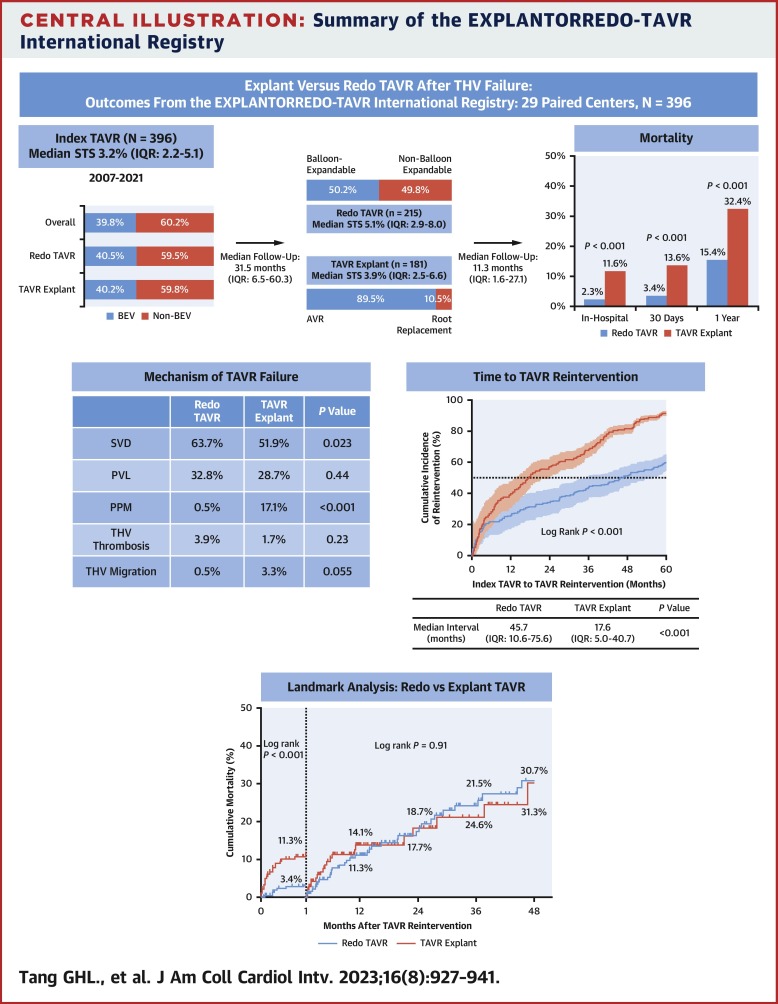
The authors sought to determine outcomes of TAVR surgical explantation (TAVR-explant) vs redo-TAVR because they are largely unknown. From May 2009 to February 2022, 396 patients in the international EXPLANTORREDO-TAVR...
Conclusions: In this first report of the EXPLANTORREDO-TAVR global registry, TAVR-explant had a shorter median time to reintervention, with less structural valve degeneration, more prosthesis–patient mismatch, and similar paravalvular leak rates compared with redo-TAVR. TAVR-explant had higher mortality at 30 days and 1 year, but similar...
Redo Surgical Aortic Valve Replacement After Prior Transcatheter Versus Surgical Aortic Valve Replacement
Source : https://www.sciencedirect.com/science/article/abs/pii/S1936879823005745?via=ihub
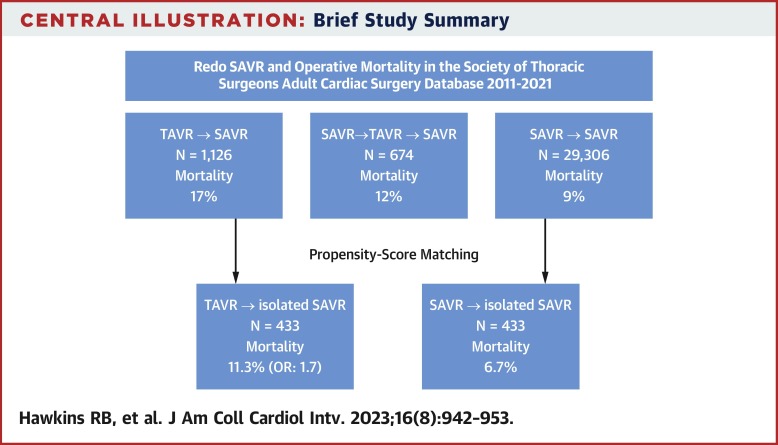
The data for this research were provided by the Society of Thoracic Surgeons' (STS) National Database Participant User File Research Program. Data analysis was performed at the investigators' institutions. Based...
Conclusions: The number of post-TAVR reoperations is increasing and represent a high-risk population. Yet even in isolated SAVR cases, SAVR after TAVR is independently associated with increased risk of mortality. Patients with life expectancy beyond a TAVR valve and unsuitable anatomy for redo-TAVR should consider a SAVR-first approach.