


Recurrent Neisseria cinerea bacteremia secondary to cardiovascular implantable electronic device infection
Source : https://www.sciencedirect.com/science/article/pii/S2214250923000690?via=ihub
We present the first case of cardiac implantable electronic device (CIED) infection due to Neisseria cinerea in a 64-year-old woman from Panama. She h...
Conclusions/Relevance: N. cinerea is an aerobic gram-negative commensal diplococcus typically found in the human nasopharynx. Infection in humans is rare with few case reports in the literature.
Contemporary issues and lifetime management in patients underwent transcatheter aortic valve replacement - Cardiovascular Intervention and Therapeutics
Source : https://link.springer.com/article/10.1007/s12928-023-00924-z
Latest clinical trials have indicated favorable outcomes following transcatheter aortic valve replacement (TAVR) in low surgical risk patients with severe aortic stenosis. However, there are unanswered questions particularly in younger...
Conclusions/Relevance: Contemporary issues in the current TAVR era include prosthesis-patient mismatch, heart failure hospitalization, subclinical thrombosis, future coronary access, and valve durability. In this review, the authors review available evidence and discuss each remaining issues and theoretical treatment strategies in lifetime...
Mosaic loss of Y chromosome in monocytes is associated with lower survival after transcatheter aortic valve replacement
Source : https://academic.oup.com/eurheartj/advance-article/doi/10.1093/eurheartj/ehad093/7080274?login=false
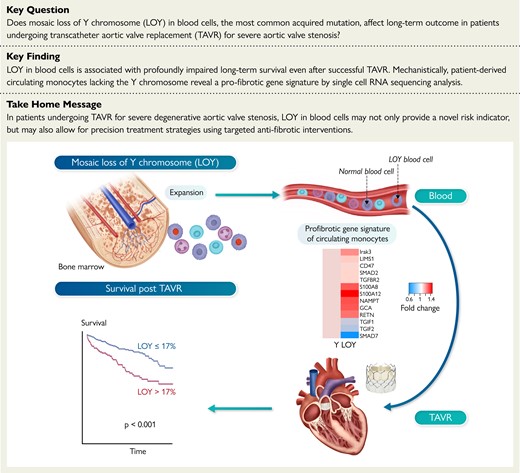
Mosaic loss of Y chromosome (LOY) in blood cells is the most common acquired mutation, increases with age, and is related to cardiovascular disease. Loss of Y chromosome induces cardiac...
Conclusions/Relevance: This is the first study to demonstrate that LOY in blood cells is associated with profoundly impaired long-term survival even after successful TAVR. Mechanistically, the pro-fibrotic gene signature sensitizing the patient-derived circulating LOY monocytes for the TGFβ signaling pathways supports a prominent role of...

Correlation of N-terminal-pro-Brain Natriuretic Peptide (NT-pro-BNP) with postoperative outcomes of older patients undergoing transcatheter aortic valve replacement
Source : https://journals.lww.com/jcma/Abstract/9900/Correlation_of_N_terminal_pro_Brain_Natriuretic.194.aspx
able biomarker of heart failure. Studies on correlation between higher NT-pro-BNP levels and adverse prognoses after TAVR have yielded inconsistent results. Here, we investigated whether preoperative NT-pro-BNP levels are correlated...
Conclusion: For older patients undergoing TAVR with NT-pro-BNP levels > 4853 ng/L, their postoperative outcomes and 1-year mortality were correlated. Thus, NT-pro-BNP is useful for the risk assessment of patients undergoing TAVR and should be regarded as a biomarker in future risk assessments.

Predictive effect of nutritional scores assessment for 1-year mortality in patients with severe aortic stenosis treated with SAVR or TAVR - PubMed
Source : https://pubmed.ncbi.nlm.nih.gov/36930487/
In the surgical or transarterial treatment of symptomatic severe aortic stenosis, we found that a high CONUT score and a low PNI score were predictors of all-cause mortality at 1-year...
Conclusions: In the surgical or transarterial treatment of symptomatic severe aortic stenosis, we found that a high CONUT score and a low PNI score were predictors of all-cause mortality at 1-year follow-up, regardless of the type of treatment. We think that checking patients with scores like the abovementioned procedure and making the...