


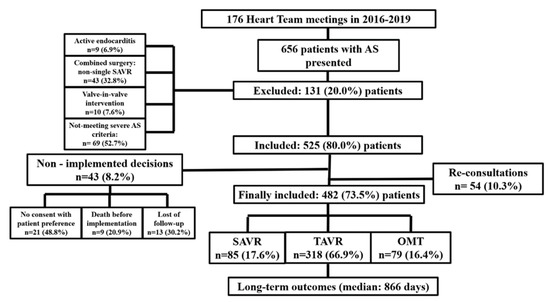
Heart Team for Optimal Management of Patients with Severe Aortic Stenosis-Long-Term Outcomes and Quality of Life from Tertiary Cardiovascular Care Center
Source : https://www.mdpi.com/2077-0383/10/22/5408
Background: This retrospective study was proposed to investigate outcomes of patients with severe aortic stenosis (AS) after implementation of various treatment strategies following dedicated Heart Team (HT) decisions.
Conclusion/Relevance: We demonstrated that after careful implementation of HT decisions interventional strategies compared to OMT only provide superior outcomes and quality of life for patients with AS. View Full-Text
Keywords: heart team; aortic stenosis; heart failure; transcatheter aortic valve replacement; surgical aortic valve...

Outcomes of the Valve-Sparing Root Replacement Procedure with Partial Upper Sternotomy - PubMed
Source : https://pubmed.ncbi.nlm.nih.gov/34821707/
Due to better postoperative convalescence and quality of life, experienced centers focus on minimally invasive surgical techniques and approaches, but this approach is not routinely performed for valve-sparing root replacement...
Conclusion/Relevance: The purpose of this study was to assess the safety and feasibility of valve-sparing root replacement via partial upper sternotomy .... Minimally invasive valve-sparing aortic replacement via partial upper sternotomy can be safely performed in selected patients.
-
Aortic Stenosis Connect4yrConclusion/Relevance: Our study demonstrates a viable application of ML-based approaches for studying and understanding complex clinical decision-making processes.

A Sneak-Peek into the Physician's Brain: A Retrospective Machine Learning-Driven Investigation of Decision-Making in TAVR versus SAVR for Young High-Risk Patients with Severe Symptomatic Aortic Stenosis - PubMed
Source : https://pubmed.ncbi.nlm.nih.gov/34834414/
Transcatheter aortic valve replacement (TAVR) has rapidly become a viable alternative to the conventional isolated surgical aortic valve replacement (iSAVR) for treating severe symptomatic aortic stenosis. However, data on younger Show More
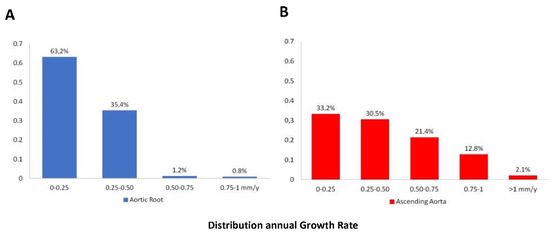
Predictors of Ascending Aorta Enlargement and Valvular Dysfunction Progression in Patients with Bicuspid Aortic Valve
Source : https://www.mdpi.com/2077-0383/10/22/5264
Bicuspid aortic valve (BAV) patients are at high risk of developing progressive aortic valve dysfunction and ascending aorta dilation. However, the progression of the disease is not well defined. We...
Conclusion/Relevance: In BAV patients, cardiovascular risk factors such as systemic arterial hypertension and dyslipidemia are related to ascending aorta dilation and aortic valve stenosis progression. Strict and early control and treatment of these modifiable risk factors should be mandatory in this cohort, even in younger patients. In...

The surgical outcomes of aortic valve replacement in patients with aortic valve lesions caused by Behcet's disease: lessons we learned - PubMed
Source : https://pubmed.ncbi.nlm.nih.gov/34790813/
doi: 10.21037/atm-21-5673. 1 Department of Cardiac Surgery, Zhongshan Hospital, Fudan University, Shanghai, China. 2 Shanghai Institute of Cardiovascular Disease, Shanghai, China. Free PMC article Xiaoning Sun et al. Ann Transl...
Conclusions: For behcet's disease patients with AR, there was a high rate of valve dehiscence after isolated AVR. When compared with traditional AVR, we found that modified AVR was the optimal choice for patients who received standardized preoperative treatment.
-
Aortic Stenosis Connect4yrKey Points • Source: Annals of Translational Medicine • Conclusion/Relevance: “For Behcet’s disease [BD] patients with AR [aortic valve regurgitation], there was a high rate of valve dehiscence after isolated AVR. When compared with Show More

Transcatheter aortic valve replacement (TAVR): Recent updates
Source : https://www.sciencedirect.com/science/article/abs/pii/S0033062021001225?via=ihub
Available online 17 November 2021 Within the last two decades, transcatheter aortic valve replacement (TAVR) has revolutionized the management of symptomatic severe aortic stenosis (AS). Newer generations of transcatheter valve...
Conclusion: In this review, we provide an update of recent clinical guidelines and available data from clinical trials and registries, and highlight novel strategies to further reduce procedural complications.